The Program: College Football
- 4.5
- Rating
- 500.00K
- Installs
- Free
- Price

 Analysis by App-foxy
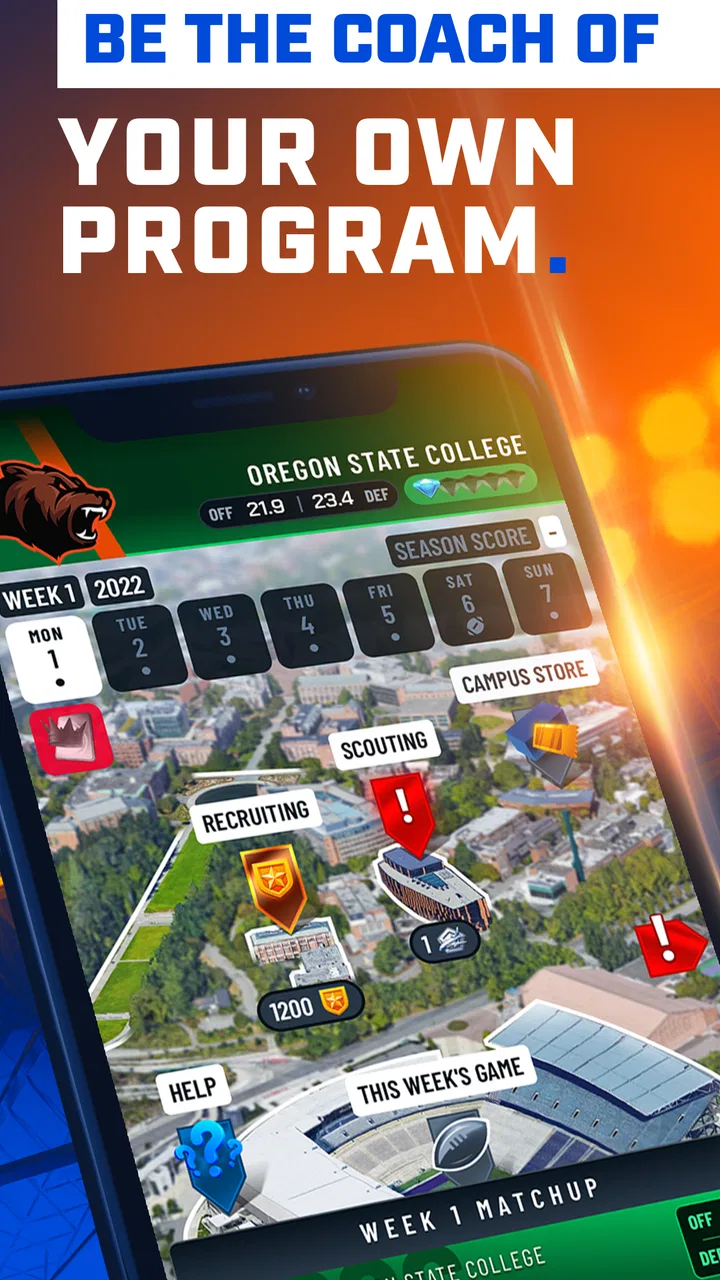
I approached The Program: College Football as a sports game for people who enjoy making decisions around a team rather than simply controlling athletes on the field. Its focus is college football management, and that immediately gives it a different rhythm from the usual arcade football title. I am not opening it for a quick match with instant action; I am opening it when I want to think about the direction of a program, weigh choices, and see whether my decisions produce a better season.
That distinction matters. The game is free to download, carries an Everyone age rating, and comes from Fantasy Moguls, Inc. It has built a sizeable audience, with over 500 thousand installs, a 4.5 average from around 23 thousand ratings, and roughly 6 thousand reviews. Those figures suggest that the idea has connected with a lot of players, but they do not tell me whether it will suit someone looking for a traditional football simulation. In my experience, the best way to judge it is to treat it as a management game first and a football game second.
What managing a college program feels like
I find the appeal of managing a college program comes from having to choose what deserves attention, rather than reacting to every moment on the field. In this section, I would look at how that slower decision-making can fit around a busy day and why setting a simple goal makes a short session feel worthwhile. That approach also leads to a more important question: how comfortable is the game when progress and competition enter the picture?
You May Also Like

 Blood Strike: 2.5 Anniversary
Blood Strike’s Loadouts Turn Every Drop Into a Tactical Gamble
A close look at Blood Strike’s custom loadouts: how fast access to signature weapons reshapes its battle royale rhythm, rewards preparation, and narrows the gap between fights.

 Pandora - Music & Podcasts
Pandora’s Music Is Easy to Start, but Harder to Recover
Pandora’s strength is its low-effort path from a seed to a station. Its weak spot is how much confidence it asks you to place in connection, setup, and quiet recovery.

 8 Ball Pool
 Is Built on Rivalries, Rematches, and Routine
A close look at the rivalries, rematches, shared routines, and unanswered safety questions that turn a quick pool match into a persistent mobile community.

 Samsung Music
’s Quiet Strength Is Playing What You Already Own
Its reach comes less from spectacle than from dependable access to a personal library. That simplicity is both the app’s strongest retention engine and its ceiling.

 AccuWeather: Weather Radar
AccuWeather Review: A Quick, Clear Forecast for Everyday Decisions
For everyday plans, the best forecast is the one you can understand quickly. AccuWeather makes rain timing, radar, and local conditions easy to act on, with a few trade-offs.

 Hill Climb Racing
Why Hill Climb Racing Still Turns Crashes Into One More Run
A tiny car, a bumpy hill and one more upgrade: Hill Climb Racing keeps resurfacing because its simple chaos makes every near-miss feel personal.
More From Our News Desk



A slower sports game built around decisions
The appeal is the feeling of responsibility. Instead of relying only on reflexes, I have to consider what kind of team I am trying to build and how carefully I want to use the resources available to me. That makes each choice feel more personal than simply selecting a strong team and playing through a fixture list.
I like this format because it works well in short sessions. I can check the state of my program, make a few meaningful decisions, and leave without needing a long uninterrupted block of time. It is a useful fit for a commute, a lunch break, or an evening when I want a sports game that does not demand constant attention. The trade-off is that players who want immediate action may find the management pace too restrained.
The college setting also gives the game a particular identity. A professional football manager can feel like a business simulator, while this game leans into the idea of building a program and dealing with the pressure that comes with it. Even when the individual action is not the main focus, the larger question remains engaging: can I turn a struggling team into one that deserves more respect?
Progress is more satisfying when I set a clear plan
One useful approach is to decide on a team identity before making choices. I get more from the game when I am not changing direction after every setback. For example, I might commit to developing a balanced squad, protecting consistency, or accepting short-term weakness in exchange for a longer rebuild. That simple rule gives the season a sense of shape and makes the outcome easier to evaluate.
This is one of the less obvious strengths of a management game. A win is not the only sign that a decision worked. Sometimes a choice is valuable because it keeps a season from collapsing, preserves momentum, or gives me a clearer route forward. I recommend keeping a mental note of why I made a major decision. Without that habit, it is easy to react emotionally to the latest result and lose sight of the wider plan.
There is also a pressure loop that can make ordinary choices feel important. When a team is performing well, I am tempted to take a bigger risk. When results turn against me, I naturally want to repair everything at once. The smarter response is usually to identify the single issue that is hurting the program most and address that first. That is a practical lesson for new players: do not treat every disappointing result as proof that the entire strategy needs replacing.
Why the game can feel demanding without being complicated
The challenge comes less from complicated controls and more from uncertainty. I may understand what I want to do, yet still have to accept that a sensible decision does not guarantee an ideal result. That makes the experience more believable than a system in which the strongest option always produces the best outcome.
At the same time, this can create friction. If I prefer games that explain every consequence immediately, the management style may feel opaque. A player who enjoys discovering systems gradually will probably be more patient. Someone who expects a detailed explanation for every change may want to spend time learning the game’s patterns before deciding whether the lack of instant clarity is enjoyable or irritating.
How I would use it in an ordinary day
Imagine having ten minutes before leaving home. I would open the game, review the current state of my college program, make one or two deliberate adjustments, and stop before turning the session into a rushed series of guesses. Later, I could return with a better idea of what I want to accomplish. This works because the game’s central appeal is planning, not frantic input.
For a longer evening session, I would set myself a specific target rather than simply tapping through everything available. A target might be stabilizing a difficult stretch, testing a new direction, or seeing whether a recent decision has improved the team. This keeps the game from becoming a repetitive routine and makes progress easier to notice.
Spending, access, and the free starting point
The game is free, but it includes in-app purchases priced from $0.99 to $9.99 per item. That is the key spending context I would want to understand before installing it. I can begin without paying, while optional purchases create a route for players who choose to spend. The presence of those purchases does not automatically make the experience unfair, but it does mean that a completely no-spend player and a paying player may approach the game with different expectations.
I would recommend deciding on a personal spending boundary before getting invested. That is especially useful in a progression-focused sports game, where the desire to improve a struggling program can make a purchase feel more attractive after a frustrating session. If I want the game to remain a free hobby, I should treat purchases as entirely optional and judge the experience by what I can accomplish without them.
There is a practical trade-off here. Paying may be appealing to someone who wants to move faster, while a patient player may prefer to experience the gradual process. I would not spend simply because a result went badly. I would first ask whether the problem comes from my strategy, my expectations, or a genuine progression barrier. That pause helps keep the decision about enjoyment rather than frustration.
Fairness, competition, and the questions I would ask before committing
Before I commit to a management game, I want to know whether I can enjoy it without spending and whether its competitive side feels fair to me in practice. I would treat those as questions to explore gradually, not conclusions to draw from the presence of optional purchases alone. With that in mind, I’ll consider who is likely to enjoy this college-football approach, who may prefer another kind of sports game, and what I would watch for while trying it.
Can a no-spend player enjoy the game?
Yes, the free entry point makes it reasonable to try without committing money. I would install it to see whether the management loop itself is enjoyable before considering any purchase. That is the most sensible test because the core question is not whether spending is available; it is whether I like making decisions about a college football program.
My advice is to play patiently at first. Do not judge the game after one poor result or assume that a purchase will automatically fix an unclear strategy. Give yourself enough time to understand how the program responds to your choices. If the free experience already feels engaging, optional spending can remain a personal convenience. If it feels repetitive without paying, that is a warning that the game may not match your preferred style.
Does spending decide competitive success?
I would be careful about making a stronger claim than the purchase information supports. The game has optional items in the stated price range, but that alone does not establish how much they influence competition or progression. I would therefore approach competitive play with an open but cautious mind rather than assuming either perfect fairness or automatic pay-to-win behavior.
For me, the safest way to preserve a fair experience is to focus on decision quality and avoid comparing my progress too closely with players who may have chosen to spend. If competition is the main reason I play sports games, I would pay close attention to how the game feels over time. If my enjoyment depends on equal conditions, I would want to understand the role of purchases through personal play before investing heavily in the result.
What kind of player should skip it?
I would skip this game if I want licensed-style presentation, direct control of every moment, or a quick match that can be won through timing and reflexes. It is also not the best fit for someone who dislikes waiting for decisions to produce results. A football fan may love the subject but still prefer an action game if the main pleasure comes from passing, tackling, and controlling the play personally.
I would also hesitate to recommend it to players who want a completely transparent progression path from the first session. Management games often ask for patience, and this one is better approached as a long-form decision experience than as a sequence of instantly explained rewards. If that sounds like work rather than entertainment, another sports game would probably be a better choice.
Who is likely to enjoy it most?
The strongest audience is someone who likes sports strategy, gradual improvement, and the feeling of guiding a team through difficult choices. It is especially suitable for players who enjoy asking “what should I do next?” rather than “how quickly can I complete this match?” The college football theme adds personality, while the management structure gives the game enough room for planning.
I also think it suits people who enjoy replaying decisions mentally. After a disappointing outcome, I tend to think about what I could have handled differently. That habit makes the game more rewarding because setbacks become information. Players who only want a guaranteed reward after every action may find the same uncertainty discouraging.
How it compares with ordinary sports alternatives
Compared with an arcade football game, this is less immediate and less dependent on manual skill. The advantage is that I can enjoy it even when I do not want to perform every play myself. Compared with a larger, more detailed management simulator, it is easier to approach as a mobile game and better suited to shorter visits, although players seeking exhaustive control may want something deeper.
That middle position is its most useful selling point for me. It is more thoughtful than a quick match, but it does not need to become a spreadsheet-heavy hobby before I can enjoy it. The compromise is that neither side gets everything: action fans may find it too passive, while dedicated simulation fans may want more depth. I would choose it when I want the idea of running a college football program without turning every session into a major time commitment.
Version, compatibility, and practical expectations
The current version is 1.16.10, and the game requires Android 7.0 or newer. That makes checking the operating system worthwhile before downloading, particularly on an older device. Since the game is built around management rather than demanding real-time action, I would expect the main question to be whether the interface feels comfortable on my phone, not whether I can perform advanced controls.
The Everyone rating also makes it broadly approachable from an age-classification standpoint. That does not mean every player will enjoy the same pace, but it does make the game easier to consider for a general audience interested in college football management.
What I would still evaluate during a trial period
My first check would be whether the game explains the consequences of decisions clearly enough for me to improve. My second would be whether progress remains satisfying without purchases. My third would be whether the competitive side feels comfortable when players may choose different spending paths. These are not questions I would answer from a single session; they require noticing how the experience develops.
I would also watch for repetition. A management loop can be enjoyable at first and lose its appeal if every season begins to feel identical. The best sign is that my decisions continue to create different problems and priorities. If I find myself tapping through events without thinking, the game has probably stopped giving me the strategic involvement I wanted.
My trust verdict
My overall view is positive, with sensible limits. The game offers a focused way to enjoy college football through planning, patience, and program-building decisions. It is free to start, has a broad age rating, and has attracted a substantial player base. The optional purchases deserve attention, especially for anyone sensitive to spending pressure, but I would not treat their existence alone as proof that the game is unfair.
The best reason to try it is the management loop, not the promise of instant football action. I would recommend it to a friend who enjoys building a team gradually and making choices under pressure. I would not recommend it to someone who wants direct control, rapid matches, or a completely predictable route to success.
My practical recommendation is to begin as a no-spend player, set a clear goal for the program, and judge the game by how much thought it encourages before buying anything. If the decisions remain interesting and the pace feels comfortable, The Program: College Football can become a satisfying sports-management companion. If the uncertainty, slower rhythm, or spending context bothers you early on, it is better to move to a more action-focused or more transparent alternative rather than trying to purchase your way into enjoying it.
FAQs for The Program: College Football
01What features does The Program: College Football offer?
The Program: College Football offers a comprehensive experience for fans, including real-time game simulations, detailed player statistics, and team management options. Users can draft players, manage rosters, and compete in various leagues and tournaments. The app also provides live updates and news, ensuring fans stay informed about their favorite teams.
02Is The Program: College Football free to download?
The Program: College Football is free to download, but it may offer in-app purchases. These purchases can enhance the gaming experience by unlocking premium features, additional content, or resources. It's important to check the app's store page for details on costs and decide if these extras are worthwhile for your gameplay.
03What are the system requirements for The Program: College Football?
The Program: College Football requires Android or iOS devices with a recent operating system version for optimal performance. It’s recommended to have at least 2GB of RAM and sufficient storage space to accommodate the app and any additional data downloads. Always check the app store for specific requirements tailored to your device.
04How does multiplayer mode work in The Program: College Football?
Multiplayer mode in The Program: College Football allows you to compete against friends or other players worldwide. You can join leagues, participate in tournaments, and climb leaderboards. A stable internet connection is necessary to ensure smooth gameplay, and you might need to create an account for matchmaking and leaderboards.
05Can I play The Program: College Football offline?
While some features of The Program: College Football may be available offline, such as managing your roster or viewing saved statistics, a majority of the game requires an internet connection. This includes real-time updates, multiplayer modes, and live simulations to ensure the most engaging and interactive experience.
Pros
- Comprehensive team stats and rankings.
- Real-time game updates and scores.
- User-friendly interface for easy navigation.
- Customizable notifications for favorite teams.
- Detailed player profiles and histories.
Cons
- Occasional slow loading times.
- Frequent ads can be disruptive.
- Limited access without subscription.
- Some features need better explanations.
- Inconsistent updates on minor leagues.

The Program: College Football
Gallery